The Complete Tax Document Checklist for Accountants and Their Clients
2026-09-05
Every accounting firm has faced the same situation.
A client says, "I think that's everything."
Then, three weeks later, you discover that an important 1099 was never provided. You send another email. The client searches through their files. Another document turns up. Then another.
The problem usually isn't that clients don't want to cooperate. It's that they don't always know exactly what documents they need to provide.
The solution is simple: request smarter, not harder.
A clear, categorized tax document checklist gives clients a straightforward way to gather their records while giving accountants a repeatable process for tracking what's been received and what's still missing.
Below is a practical financial documents list and tax document checklist that accounting firms can use as a starting point for individual clients, freelancers, contractors, and small business owners.
1. Identity Documents
Start with the documents that establish the client's identity and basic personal information.
- Government-issued ID card or passport copy
- Proof of address
- Social Security card or other applicable identification records
These documents typically do not change from year to year. However, they should be confirmed for new clients and for anyone who has changed their name, address, or other identifying information during the year.
Accountant tip: Instead of requesting these documents from every returning client automatically, consider making them part of your onboarding or annual information-confirmation process.
2. Income Documents
Income documentation is one of the most important parts of the tax preparation process.
Depending on the client's circumstances, request the applicable documents, including:
- W-2 forms
- 1099-NEC or 1099-MISC for contractors and freelancers
- 1099-INT for interest income
- 1099-DIV for dividend income
- Prior year's income tax return
- K-1 schedules for partnership, S-corporation, or other applicable pass-through income
- Salary slips, salary certificates, or equivalent income records where applicable
This category often creates the most back-and-forth between accountants and clients. The reason is simple: clients may know that they earned income, but they don't necessarily know which tax forms they should have received.
A better approach is to give clients a checklist that explains the common forms and allows them to identify which ones apply to their situation.
3. Financial Records
Financial records can help identify income, transactions, interest, investment activity, and other information relevant to the tax return.
Request applicable records such as:
- Bank statements
- Investment or brokerage statements
- Interest statements
- Dividend statements
- Retirement account statements
- Other relevant financial statements
For clients with multiple bank or investment accounts, make sure the checklist encourages them to provide records for all applicable accounts, not just their primary account.
4. Business Documents
Self-employed individuals, freelancers, contractors, and small business owners generally need a more detailed document request.
Depending on the business, consider requesting:
- Business registration certificate
- Profit and loss statement
- Business bank statements
- Sales invoices
- Purchase invoices
- Expense receipts or expense summaries
- Payroll records
- Accounts receivable and payable records
- Business loan statements
- Asset and equipment purchase records
- Relevant bookkeeping reports
Not every business will need every item on this list. The goal is to give clients a clear framework while allowing the accountant to select the documents relevant to that particular business.

5. Property and Asset Documents
Property ownership can introduce additional records that may be relevant to tax preparation.
Depending on the client's situation, request:
- Property purchase documents
- Property sale documents
- Mortgage statements
- Mortgage interest statement, such as Form 1098 where applicable
- Property tax statements
- Rental property income records
- Rental property expense records
- Utility bills where relevant
- Records of major property improvements
- Insurance documents
- Asset purchase and disposal records
For clients who own rental properties or other income-producing assets, keeping these documents organized throughout the year can make tax preparation considerably easier.
6. Insurance and Deduction Records
Deductions and credits are another area where missing documentation can lead to unnecessary follow-up.
Depending on the client's circumstances, request:
- Health insurance forms, such as Form 1095-A, 1095-B, or 1095-C where applicable
- Loan statements
- Charitable donation receipts
- Student loan interest statement, such as Form 1098-E
- Medical expense records where applicable
- Education-related expense records where applicable
- Business expense documentation
- Other records supporting deductions or credits
The exact documents required will vary depending on the taxpayer's circumstances and the tax year.
7. Why a Categorized Tax Document Checklist Works Better
A flat list of 20 or 30 document names may look comprehensive, but it's surprisingly easy for clients to skim over important items.
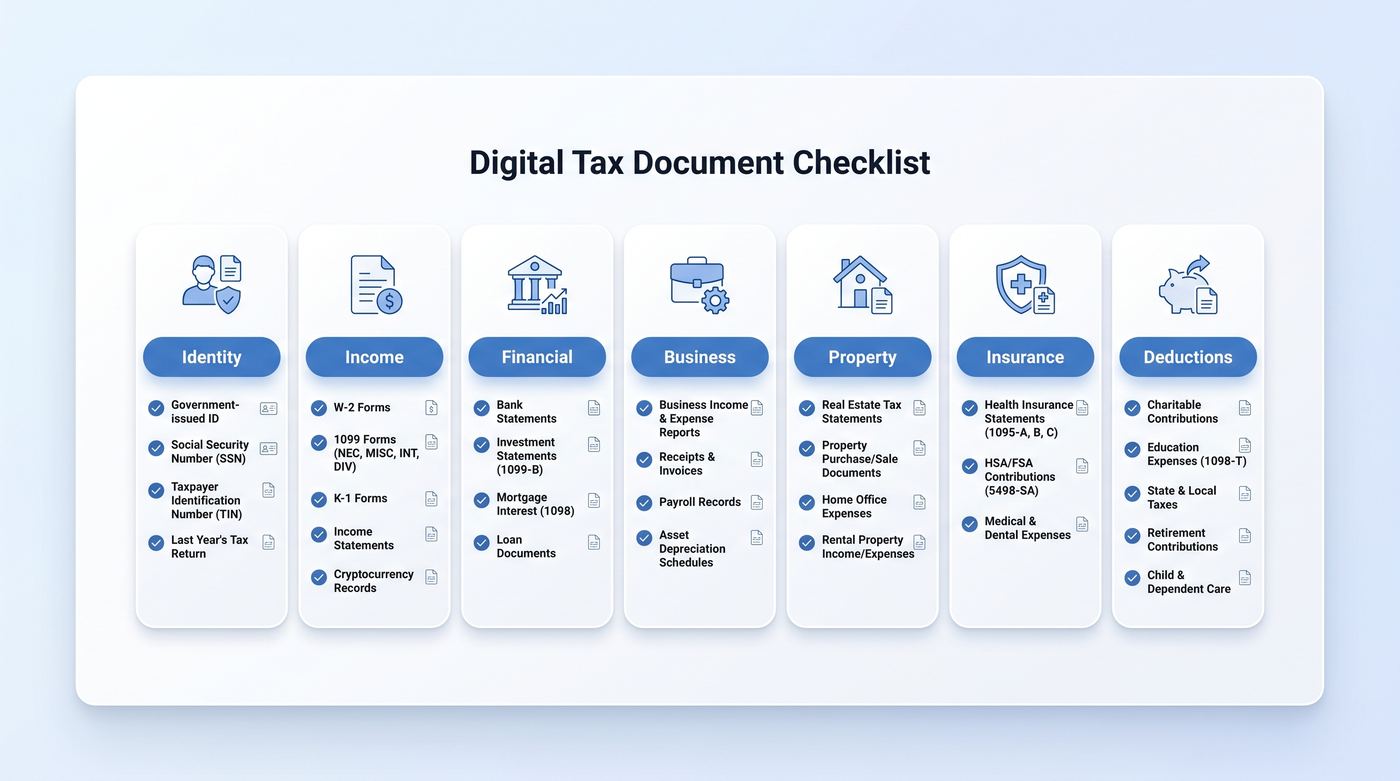
A categorized checklist works differently. Instead of presenting clients with one long list, it organizes their paperwork into familiar groups:
Identity → Income → Financial → Business → Property → Insurance → Deductions
This makes the request easier to understand and easier to complete. Clients can work through one category at a time instead of trying to figure out what each document on a long list means.
For accountants, the benefits are just as important:
- Fewer missing documents
- Less email back-and-forth
- More consistent client onboarding
- Faster document collection
- Easier follow-up
- A repeatable process for every filing season
The IRS also emphasizes maintaining appropriate records to support income, deductions, and other items reported on tax returns — see the IRS recordkeeping guidelines for the underlying requirements this checklist is built around. A categorized checklist helps turn that recordkeeping principle into a practical client-facing process.
Important: This checklist is a practical starting point, not a substitute for professional tax advice. Document requirements vary based on the taxpayer, business structure, jurisdiction, and tax year. Accountants should customize their requests accordingly.
8. Turn the Checklist Into a Repeatable Process
Creating a checklist is useful. Having to manually copy and paste that checklist into an email for every client is not.
Once an accounting firm has dozens or hundreds of clients, manually requesting documents can quickly become a time-consuming administrative task.
A better process is to create a standardized document request that can be reused for every filing year. For example:
- Step 1: Select the client and applicable document categories.
- Step 2: Send one organized document request.
- Step 3: Let the client upload the requested files through a secure link.
- Step 4: Track which documents have been received.
- Step 5: Follow up only on the items that are still outstanding.
This turns document collection from a scattered email conversation into a structured workflow.
9. How Kredofy Simplifies Client Document Collection
This is where a checklist becomes much more useful when it's built into your workflow.
Kredofy lets accountants turn a document checklist into a simple client request. Instead of creating a new email and manually listing every document, accountants can select the categories that apply to the client and send a single request.
The client receives a secure link with no login required, making it easier for them to submit their documents.
On the accountant's side, the dashboard makes it clear what has been received and what is still outstanding. That means fewer "Did you send this already?" emails and less time spent searching through inboxes.
One checklist. One secure link. One place to track what's missing.
Final Tax Document Checklist
For quick reference, here's the complete checklist:
Identity
- ☐ ID card or passport
- ☐ Proof of address
- ☐ Social Security card or applicable identification
Income
- ☐ W-2 forms
- ☐ 1099-NEC / 1099-MISC
- ☐ 1099-INT
- ☐ 1099-DIV
- ☐ Prior-year tax return
- ☐ K-1 schedules
- ☐ Salary slips or certificates
Financial
- ☐ Bank statements
- ☐ Brokerage statements
- ☐ Investment statements
- ☐ Retirement account statements
- ☐ Other applicable financial records
Business
- ☐ Business registration documents
- ☐ Profit and loss statement
- ☐ Business bank statements
- ☐ Sales invoices
- ☐ Purchase invoices
- ☐ Expense receipts or summaries
- ☐ Payroll records
- ☐ Business loan statements
- ☐ Asset and equipment records
Property & Assets
- ☐ Property purchase documents
- ☐ Property sale documents
- ☐ Mortgage statements
- ☐ Form 1098, where applicable
- ☐ Property tax statements
- ☐ Rental income records
- ☐ Rental expense records
- ☐ Utility bills where relevant
- ☐ Property improvement records
- ☐ Insurance documents
Insurance & Deductions
- ☐ Health insurance forms
- ☐ Loan statements
- ☐ Charitable donation receipts
- ☐ Form 1098-E, where applicable
- ☐ Medical expense records where applicable
- ☐ Education-related records where applicable
- ☐ Business deduction records
- ☐ Other supporting documentation
The Bottom Line
A good tax document checklist does more than tell clients what to send.
It creates a repeatable system for collecting information, reduces unnecessary follow-ups, and gives accountants a clearer picture of what's complete and what's still missing.
The key is to keep the checklist organized, customize it for each client's situation, and make the submission process as simple as possible.
Because the less time accountants spend chasing documents, the more time they can spend doing the work their clients actually hired them to do.
Kredofy lets accountants send clients a single secure link to upload tax documents — no client login required, with automatic reminders and year-based filing built in. See how it works →